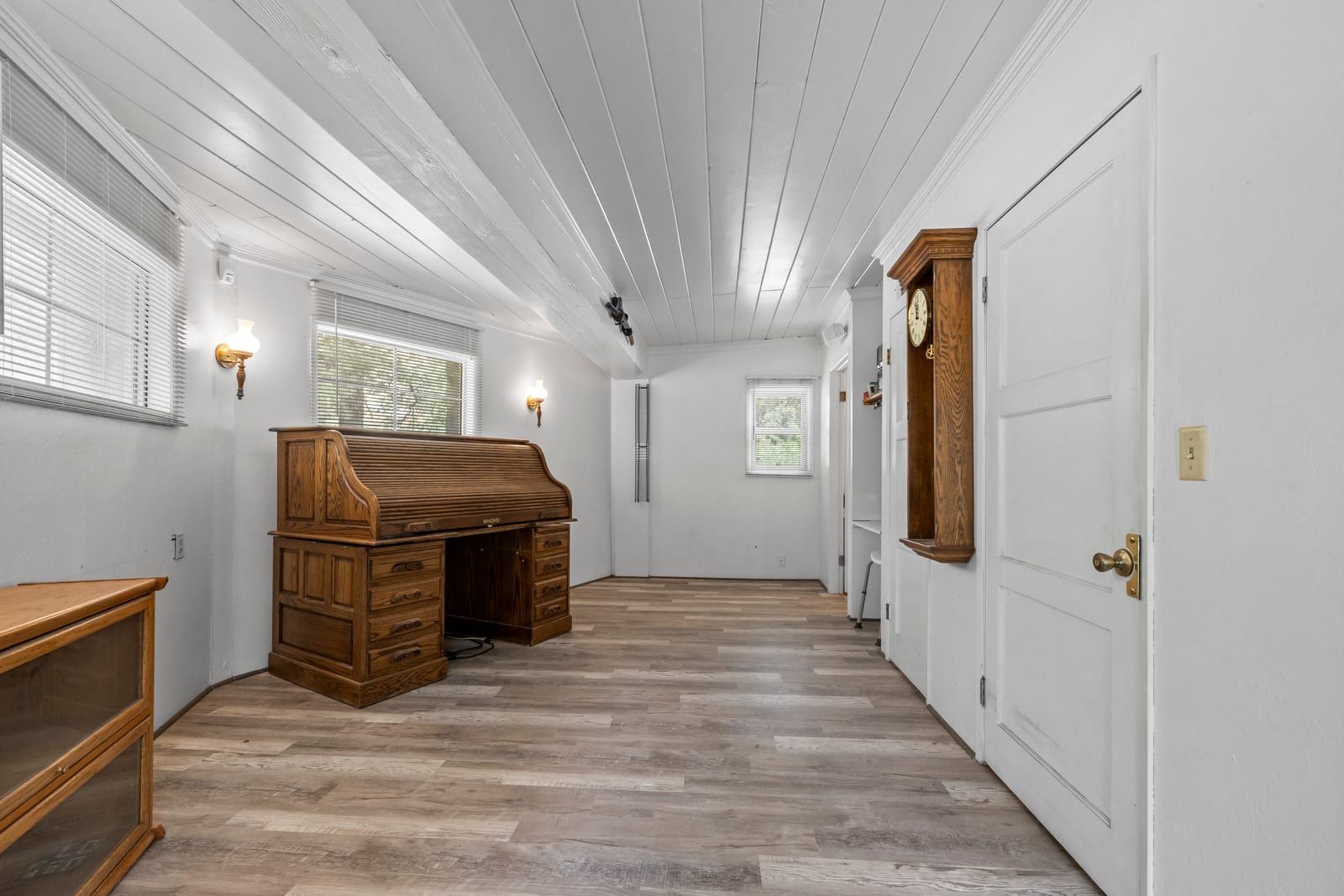
An enclosed back porch on a Claremont house is priced as what it is today: enclosed porch space, not a permitted bedroom, unless the city's permit records show the enclosure was permitted. A cash offer counts the bedrooms the permit history supports, gives the porch room the value it actually adds, and lists any work the walkthrough found on its own line. Before reading any offer, search Claremont's archived permits; an old enclosure that turns out to be permitted changes both numbers.
Why Claremont has so many of them
The oldest Claremont houses sit in and around the Village and the college blocks: Craftsman and Arts and Crafts bungalows, a few Victorians and period revival houses, many listed on or eligible for the city's Register of Structures of Historical and Architectural Merit. These are the houses with original knob-and-tube circuits, galvanized plumbing, raised foundations, and back porches that were closed in at some point and became bedrooms.
Claremont Heritage describes the bungalow's front porch as usually held up by flared posts of rock or brick. That front porch is the face of the house and usually survives. The back porch is the one that got walls, windows and a bed. That is why the question on a Village file is rarely "is there a porch room?" and usually "what does the permit record say about it?"
Step one: search the permit record before anything else
The City of Claremont's Building and Construction page links to a search of archived permits, and its building permits page says permits are required when constructing, remodeling or enlarging a building or structure. Search the address before you assume the porch room is unpermitted. Three outcomes are possible, and each prices differently.
What the record showsHow the porch room is countedAs-is cash offerOpen-market read
A permit and final inspection for the enclosure
As permitted living area, priced against comps with the same room count
-
-
A permit with no final, or a permit for something else
As unresolved space; the gap between permit and finish is a line item
-
-
No record at all
As enclosed porch space with the value it adds, not as a bedroom
-
-
The full method for pulling a record, and what to do when the archive is incomplete, is in permit history: how to look yours up. If the record is unclear, ask the city's Building Division directly before you sign anything that describes the room.
What "priced as it exists" means on the offer sheet
A Village bungalow with two permitted bedrooms and an enclosed porch used as a third is a two-bedroom house with a porch room, as far as the comps are concerned. That is not a penalty. It is the same rule a financed buyer's appraiser follows, and the reason enclosed porches are among the items that shorten appraisals on financed Claremont sales; see why appraisers cannot count unpermitted living area.
On the cash side, the porch room shows up in three places:
- The comps. The starting value comes from Village houses with the same permitted bedroom count and similar register status, not from three-bedroom sales.
- The porch room's own value. A closed-in, usable room is worth something to the next owner even uncounted, as a study, a sunroom or storage. The offer should show what it credits, not drop the room to zero.
- The unpermitted space line. If the buyer plans to legalize, restore or remove the enclosure, that plan has a cost, and it belongs on its own row.
Porch room lineWhat it coversAmount
Comps at the permitted room count
Village sales with the same bedrooms and similar constraints
-
Credit for the enclosed room
Value the room adds as it stands
-
Unpermitted space
The buyer's cost to legalize, restore or remove
-
Systems feeding the room
Wiring, plumbing or heating run into the porch, as found on the walkthrough
-
Floor and foundation under the porch
Condition of the structure the walls were built on
-
Watch for an offer that starts from two-bedroom comps and then also deducts a full legalization cost. If the buyer is pricing the room as a porch, they are not paying for it as a bedroom, so charging the seller to make it one is the same room counted against you twice. The general version of this line is in the unpermitted-work line on an offer sheet.
Why a register house adds a second question
On a house that is listed on the Register or eligible for it, the porch is not only a building permit question. Claremont's Planning Division says design review applies to new construction and exterior modifications to existing structures, and the city's Register carries a waiting period before demolition permits are issued for listed structures. Claremont's Cultural Resources Preservation Ordinance, in the version the city posts with its historic preservation program, has the Architectural and Preservation Commission review changes to listed and eligible properties.
So a buyer who wants to legalize the enclosure with new windows, rebuild it larger or tear it off and restore an open porch may face preservation review on top of the building permit. That uncertainty is exactly what a cash buyer prices, and it is why the comps for a register bungalow come from other register houses rather than from unrestricted tracts. Whether review applies to your specific plan is a question for the city's Planning Division.
Legalize first, or sell it as it stands?
Legalizing an enclosed porch can mean plans, permit fees, opening walls for inspection, bringing wiring and plumbing up to current code and, on a register house, design review. Costs beyond the permit fee are covered in what legalizing costs beyond the permit fee, and the wider decision is in selling a house with unpermitted additions.
Selling as it stands leaves that work and its uncertainty with the buyer. Either way, the disclosure duty does not change because the buyer pays cash or agrees to buy as-is; disclosing unpermitted work to a buyer covers what to say and how. Disclosure questions on your own sale belong with a real estate attorney.
When listing nets more for a house with an enclosed porch
A cash offer is generally below what the open market would bring. Listing often nets more when the permit search finds the enclosure was permitted, because the room then counts. It also often nets more when the porch room is a small share of an otherwise updated Village house, when the seller has time to market it honestly as a two-bedroom with a sunroom, and when the house's systems will pass a financed buyer's inspection without a fight. In those cases the porch room is a feature to disclose, not a reason to sell at a discount, and the written recommendation says to list, with an introduction to a designated local expert who works the Village blocks.
The cash route tends to fit when the porch room is one of several items (original wiring, galvanized pipe, a raised foundation that needs work), when heirs out of state do not want to manage a permit and a design review, or when a financed sale has already stalled on the appraisal. When a Claremont house should be listed instead of sold for cash walks through the wider test.
What the walkthrough looks at in a porch room
The porch room gets the same in-person look as the rest of the house, written up so you can check it. The walkthrough on a Claremont house covers the full visit; in the porch room itself it notes:
- How the room is heated and lit, and where its wiring comes from
- Whether plumbing was run into it, as with a laundry or a half bath
- The floor: level, soft spots, and what it sits on
- Windows and the door to the yard
- Whether the room changes the front of the house, which matters on a register property
What this looks like in practice
These are the kinds of Claremont files that come in, described without names, addresses or figures.
- A successor trustee with a Village bungalow advertised for decades as a three-bedroom, whose permit search found no record for the back bedroom.
- Heirs to a period revival house on the Register who want to know whether to restore the porch, legalize it or leave it for the buyer.
- A seller whose financed buyer's appraisal came in at the two-bedroom count, now comparing a relisting with an as-is cash offer.
Getting both numbers on a Claremont house with a porch room
Bring whatever permit records you found to the walkthrough. Mr. Cali Offers is based in Claremont, and the written report puts the as-is cash offer, which comes from an independent buyer or investor, beside the open-market read, a preliminary estimate, not an appraisal, with the porch room priced as it exists on both sides. Start on the cash offer request form or call (909) 498-3977. There is no cost and no obligation to get the two numbers and the written report. See also how a Claremont cash offer is built, the Claremont area page and the Cash Offers in Claremont hub.
Sources
- City of Claremont: Building and Construction (Building Division, link to archived permit search), accessed November 6, 2026
- City of Claremont: Building Permits and Plan Checks, accessed November 6, 2026
- City of Claremont: Planning Permits (design review, Register of Structures of Historical and Architectural Merit), accessed November 6, 2026
- Claremont Heritage: Architecture, accessed November 6, 2026
- City of Claremont: Cultural Resources Preservation Ordinance (the version posted with the city's historic preservation program; confirm the current text with the city), accessed November 6, 2026
Mr. Cali Offers is not a law firm. Cash offers come from independent buyers and investors who buy for their own account and may resell for profit; a cash offer is generally below what the open market would bring. Any value shown is a preliminary estimate, not an appraisal. Nothing here is legal, tax or financial advice.
Frequently asked questions
Is an enclosed back porch counted as a bedroom when a Claremont house is sold?
Only if the permit record supports it. If the City of Claremont's archived permits show a permit and final inspection for the enclosure, it can count as living area. If there is no record, the comps use the permitted bedroom count and the porch room is credited for the value it adds as it stands.
How do I check whether my Claremont porch enclosure was permitted?
Start with the City of Claremont's Building and Construction page, which links to a search of archived permits. If the record is unclear or missing, ask the city's Building Division directly before you sign any document that describes the room as a bedroom.
Should I legalize the enclosed porch before selling my Claremont house?
It depends on the numbers. Legalizing can mean plans, fees, opened walls and code upgrades, and on a house listed on or eligible for Claremont's historic Register, possible design review. Compare the cost and time against the difference it makes in the open-market read before deciding.
Does being on Claremont's historic Register affect an enclosed porch?
It can. Claremont's Planning Division applies design review to exterior modifications, and the city's preservation review covers changes to listed and eligible properties. A buyer who wants to rebuild or remove the enclosure may face that review, which is why register houses are priced from other register houses.
When does listing a Claremont house with an enclosed porch net more than a cash offer?
Often when the enclosure turns out to be permitted, when the porch room is a small part of an otherwise updated house, or when the seller has time to market it honestly as a smaller bedroom count with a sunroom. The cash route fits better when the porch is one of several system items or a financed sale has stalled.
Written by
Anthony Grynchal
Anthony Grynchal is a California real estate salesperson with eXp Realty, licensed since November 2009 (CA DRE #01873626), and the owner of Mr. Cali Offers.
More about AnthonyPublished